
The lord whose oracle is at Delphi neither declares nor conceals
but gives a sign

Hi, welcome to I, Bodger, a newsletter about learning a new craft during lockdown. If you’d like to sign up, you can do so (it’s free!) by clicking here, or just read on...
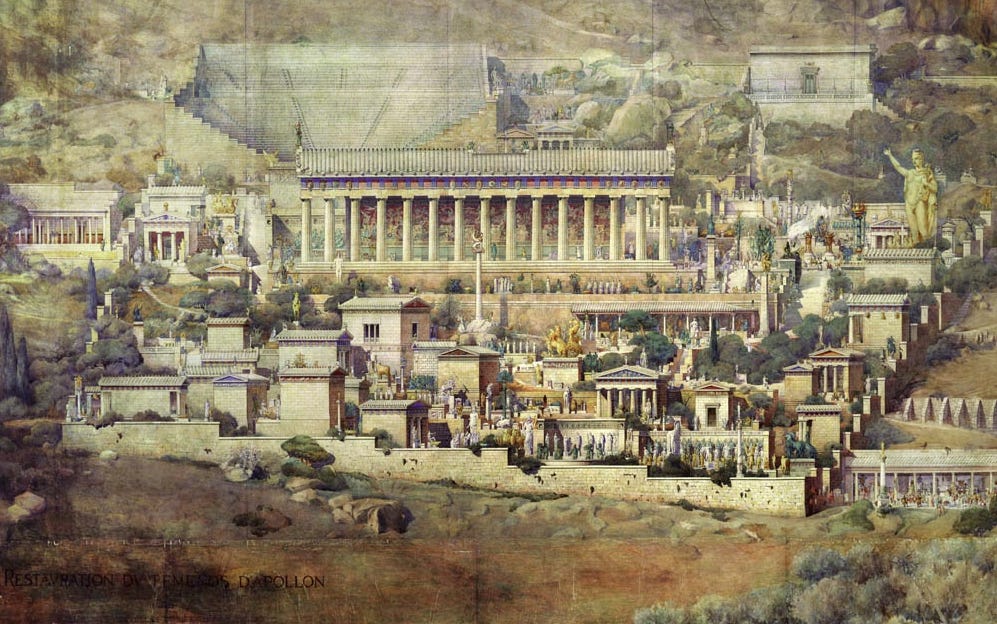
Reconstruction of the sanctuary of Apollo at Delphi by French architect Albert Tournaire, 1894. [Now at École nationale supérieure des Beaux-Arts]
They say that Zeus, when seeking the navel of “Grandmother Earth,” set loose eagles from the East and West, and where they met—at Delphi on the slope of Mount Parnassus—found the center of the world, the omphalos, the navel of Gaia. The child Apollo—god of harmony, order, and beauty—slayed Gaia’s son Python, the serpent who guarded his mother’s belly. Accordingly, after undergoing an adolescence of menial service in recompense, Apollo’s sanctuary was established at Delphi, his temple built, and his oracle—the sibyl called Pythia— ensconced upon a tripod above the chasm inside a nearby cave, to emit prophesies in trances inspired by the rising vapors. Petitioners from all over the world came to Delphi to consult the Pythia, the most important oracle of ancient Greece. Three phrases were carved on Apollo’s temple: γνῶθι σεαυτόν (gnōthi seautón = "know yourself"); μηδὲν ἄγαν (mēdén ágan = "nothing in excess"); and Ἑγγύα πάρα δ'ἄτη (engýa pára d'atē = "make a pledge and mischief is nigh").
It’s a mystery why philosophy sprung up during the sixth century BC simultaneously in so many separate unconnected places: Taoists in China, anonymous authors of Upanishads in India, Zoroaster in Iran, prophets of Exilic Israel, and the pre-Socratic thinkers of the Greek-speaking world.
And it’s a mystery why I suddenly felt obsessed by turning wood bowls at the beginning of this year.
I tend to see my work in symbolic terms, in signs. For example, when trying to divine a plan for the gargoyles, I wanted four in number—for the four directions, the four seasons, the four corners of a square. Quaternity expresses wholeness in diversity. Accordingly, I returned again and again to the four winged signs in the vision of Ezekiel:
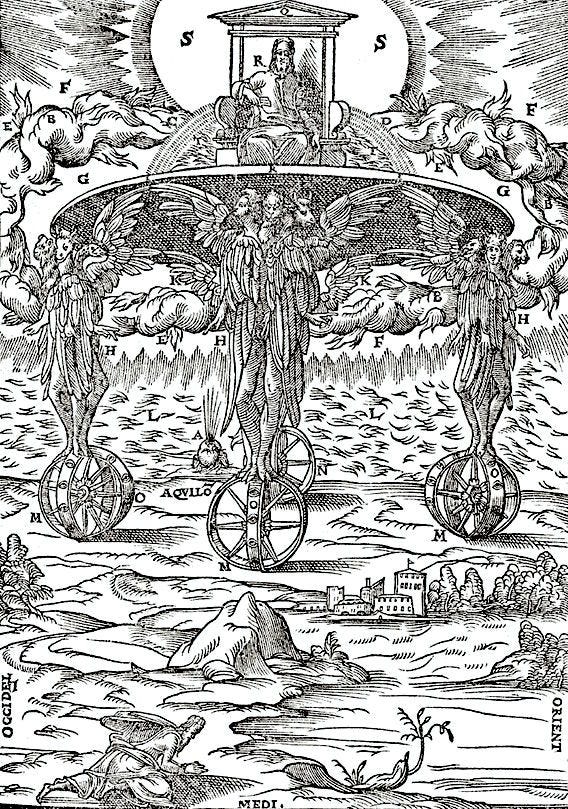
“Ezekiel saw that wheel, Way up in the middle of the air…”
The Vision of Ezekiel: wheels within wheels—the winged lion, winged bird, winged ox, and winged man—a vision of wholeness in itself.
Why suddenly bowls?
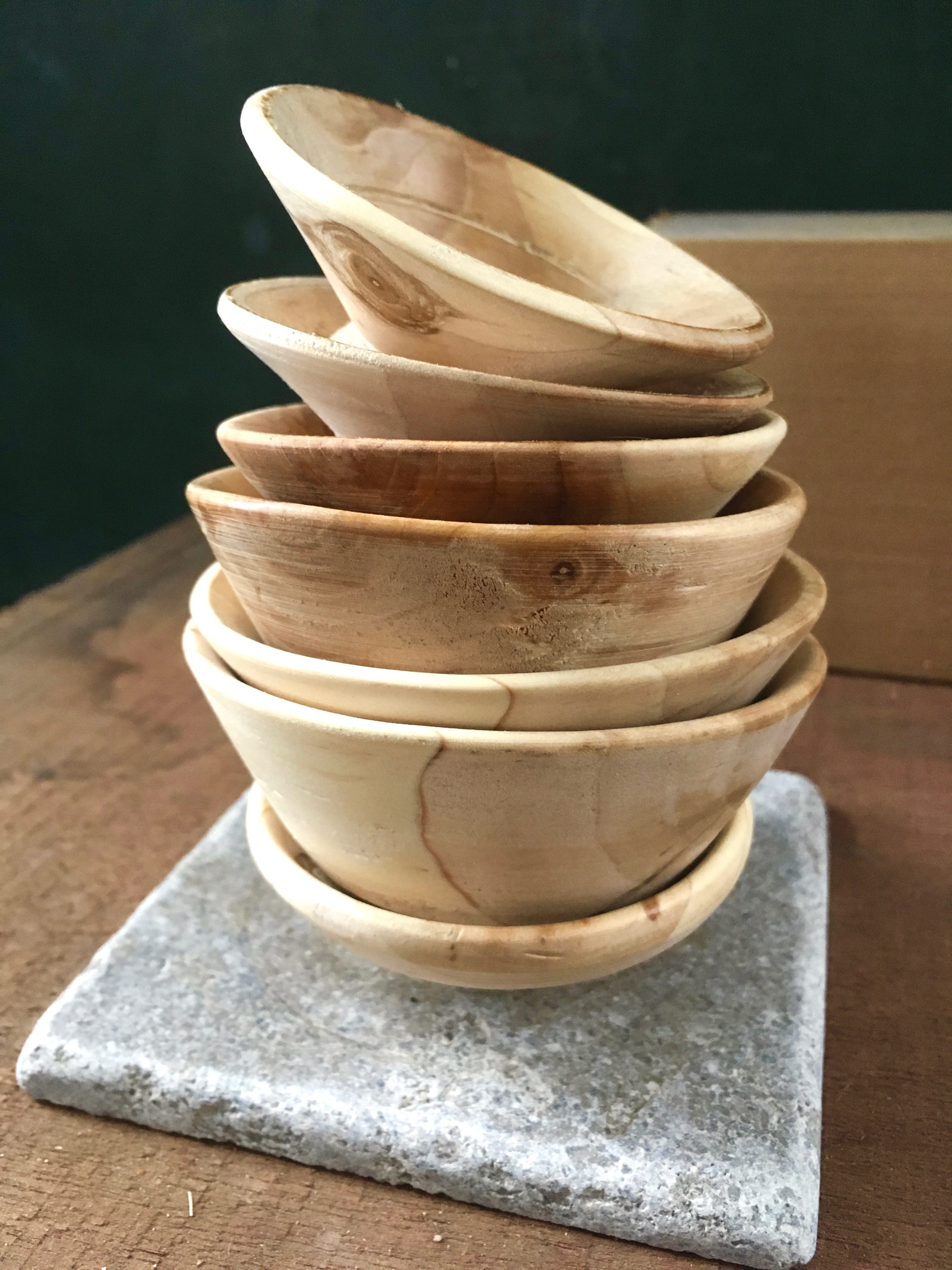
Yesterday’s stack of small bowls in apple wood.
According to J.C. Cooper’s An Illustrated Encyclopaedia of Traditional Symbols:
BOWL - A bowl of water represents the feminine receptive principle and fertility. The almsbowl signifies aloofness from life; renunciation; the surrender of the ego. Buddhist: The almsbowl is an attribute of the monk or bhikkhu. The seven small bowls of water on a shrine represent the seven offerings for an honored guest: water for drinking, water for washing, flowers, incense, lamps, perfume, food. Hindu: The bowl is an attribute of Ganesha.